
The Warning Shot vs. Doom Balance Is Better for White-Box Control Than Black-Box
This work was carried out as part of the Machine Alignment, Transparency & Security (MATS) program with Redwood Research. Gabriel Konar-Steenberg was the main contributor; thanks to Alex Mallen for mentorship and to Nikita Menon, Anastasia Wei, Nabil Baugher, and Netzer Epstein for additional review. Cross-posted to LessWrong.
Many1,2,3,4 have articulated the Warning Shot Argument against AI control. It goes: current models pose low amounts of catastrophic risk, while later models will pose higher amounts. Thus, we should avoid band-aid fixes to misbehavior that we don’t expect to work on those later models, like control, because such fixes prevent non-catastrophic “warning shots” that would wake up society to the much larger risks ahead. For instance, it would have been bad if OpenAI had had stronger control measures that had prevented the HuggingFace incident, as the HuggingFace incident caused fairly little damage but was a pretty effective warning. Here, I argue that the Warning Shot Argument bites harder against black-box control than white-box control.
The Basic Effect
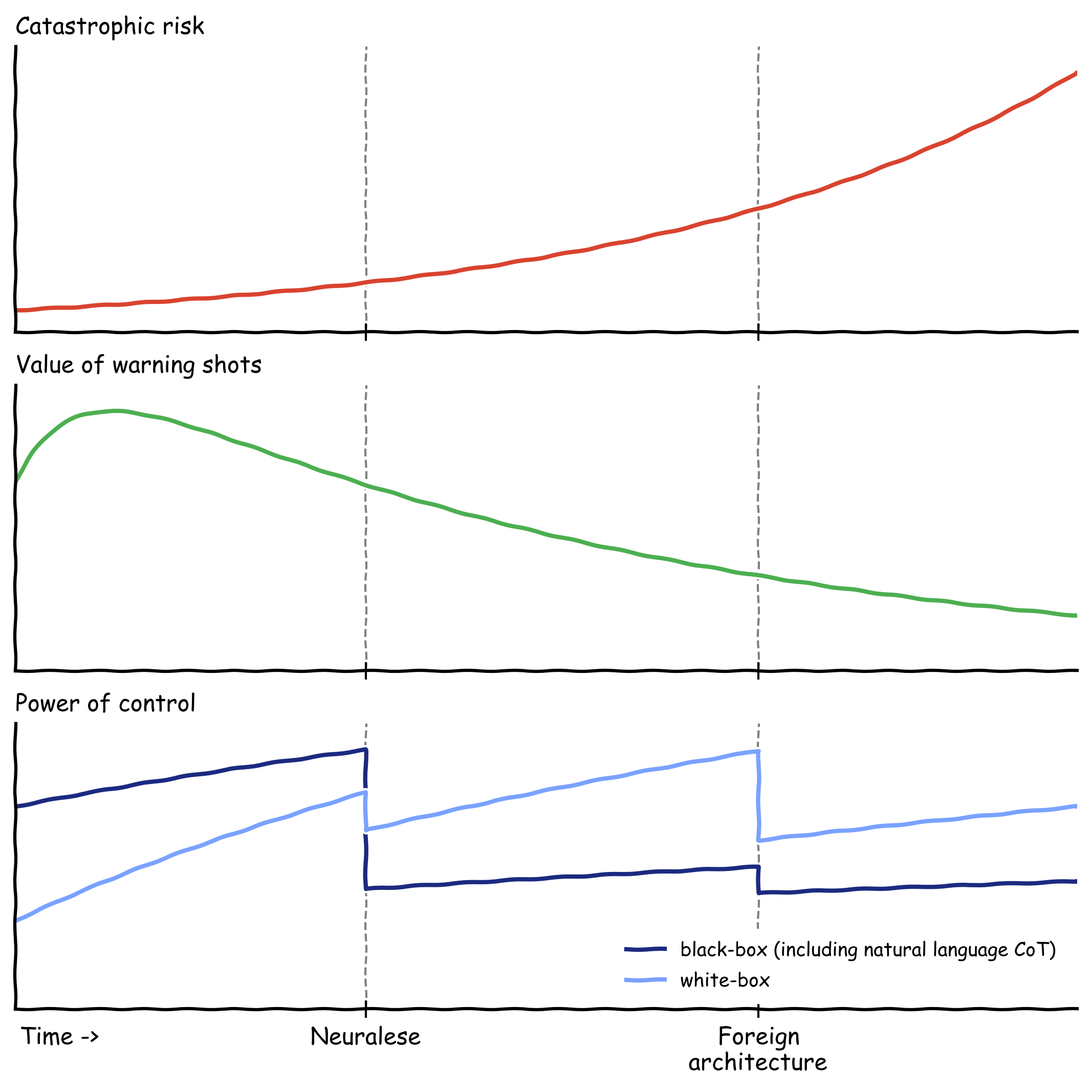
Consider the above rough sketches of how catastrophic risk from frontier models, the value of warning shots, and the “power” of AI control to avert incidents vary over time:
- Catastrophic risk increases over time as models get more powerful.
- The value of warning shots may increase in the short term as warning shots get more severe, but then gradually decreases as we run out of time to make use of the increased awareness to avoid catastrophe.
- Black-box control through the monitoring of a model’s final outputs and natural language chain of thought (CoT) becomes gradually more powerful with research progress, but suffers a major blow if frontier labs move away from natural language CoT.5 Black-box control may degrade further if the dominant architectural paradigm shifts away from language modeling.
- On the other hand, the white-box monitorability needed for control is currently weaker than the black-box equivalent6,7 but is likely to benefit substantially from further research. White-box control is also likely less impacted by a switch to neuralese as it doesn’t so inherently depend on natural language CoT, but it is likely still impacted to some degree. For instance, neuralese may make it harder to obtain ground truth to train interpretability methods on and may cause a drift in model cognition away from human concepts.8 On the other hand, white-box methods may be more impacted in the farther future by large shifts in neural network architectures if interpretability techniques do not generalize well to these new architectures.
These plots imply that, compared to black-box control, white-box control is less powerful against warning shots and more powerful against catastrophic risk. This is a consideration in favor of the adoption of white-box control over black-box control.
The Marginal Researcher’s Contribution
A detailed analysis of how additional research effort can shift these lines is beyond the scope of this post. However, for a rough sketch, we can model a researcher’s contribution to a particular agenda as a speedup of the relevant component(s) of the black- or white-box curve. Then, we can calculate a combined maximum control “power” by adding black- and white-box control powers in quadrature9 and plot how various forms of research might alter this total. Here, the gray line represents the combined control power baseline and the dotted lines represent the combined control power if extra effort in a particular agenda is continuously added:
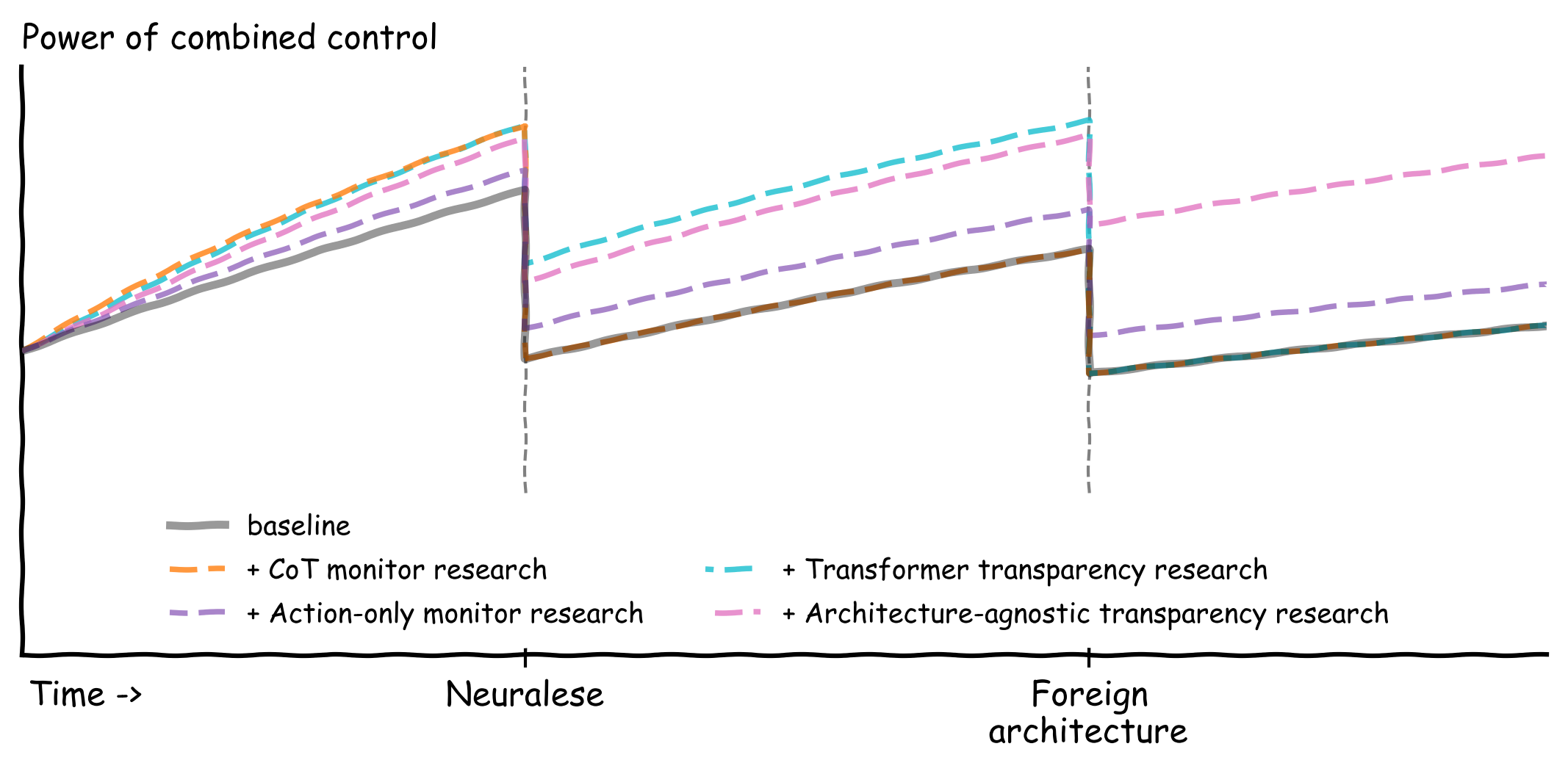
- Additional research on CoT monitors only adds power up until neuralese.
- Additional research on transformer-specific white-box transparency is a high-leverage way to add power up until transformers cease to be the dominant paradigm.
- Additional research on action-only monitors, which are already more mature, yields slowly increasing power across the whole timeline.
- Additional research on less mature architecture-agnostic white-box transparency yields a greater increase in power across the whole timeline.
The exact details of this plot shouldn’t be taken too seriously, but it’s clear that different agendas boost the curve in better or worse places for the warning shot vs. doom balance. CoT monitor research is particularly bad on this score and architecture-agnostic white-box transparency research particularly good.
Other Factors
Even if you buy the Warning Shot Argument, there are of course other factors that may influence the balance between white- and black-box control. For instance:
- In control evaluations, the red team’s job of eliciting an attack policy is substantially harder when it needs to be realistic under white-box monitoring than when it only needs to be realistic under black-box monitoring, so we may have less confidence about how powerful future white-box techniques actually are.
- Strengthening white-box control may increase frontier labs’ willingness to abandon natural language chain of thought.
- Though likely less effective than warning shots, successful control-based model “incriminations” also function as evidence of risk to wake up society. Black-box incriminations may be more legible to the public than white-box ones. Also, third-party auditors have so far been more successful in obtaining frontier model CoT access than in obtaining access to model internals.
- In addition to the specific dropoffs on my plots, black- and white-box methods likely degrade at different rates as models become very intelligent.
A full weighing of all factors is beyond the scope of this post, but I think the warning shot vs. doom balance is a useful framework to keep in mind when thinking about safety agenda prioritization.
This work was carried out as part of the Machine Alignment, Transparency & Security (MATS) program with Redwood Research. Gabriel Konar-Steenberg was the main contributor; thanks to Alex Mallen for mentorship and to Nikita Menon, Anastasia Wei, Nabil Baugher, and Netzer Epstein for additional review.
-
https://www.lesswrong.com/posts/rZcyemEpBHgb2hqLP/ai-control-may-increase-existential-risk ↩
-
https://www.lesswrong.com/posts/TfqMs3AarsHnHiwai/should-safety-researchers-quit-frontier-labs ↩
-
https://www.lesswrong.com/posts/GcYpJXqoaQHTvxLRP/blocking-monitors-are-bad ↩
-
https://www.lesswrong.com/posts/qJrhEoNbzKRQYhybh/thoughts-on-safety-bad-bc-warning-shots-good ↩
-
See https://www.aisi.gov.uk/research/loss-of-oversight-how-ai-systems-may-become-harder-to-audit-monitor-and-investigate for a detailed treatment of how various monitoring techniques degrade. ↩
-
See https://www.lesswrong.com/posts/6m29SfjbittooYojj/latent-reasoning-architectures-would-likely-undermine-cot around “new ontologies” ↩
-
I.e., we treat them as two orthogonal vectors contributing to a magnitude. To produce the baseline curves, I have modeled three subcomponents of each type of control — one that persists until neuralese, one that persists until “foreign architecture,” and one permanent — aggregated them this same way, and adjusted the parameters until the trends looked right. I emphasize that this very basic model could easily be refined. ↩